 Md Arshad
Last updated: July 2026
Quick answer: AMU Class 9 entrance question paper 2019 is useful for understanding the older Class IX paper format, MCQ style, OMR practice, time management and Class VIII-level syllabus. In 2019, the written test had 85 marks: Languages 25, Mathematics 30 and Science 30, followed by a 15-mark interview. Current students should also check the latest AMU pattern because recent Class IX papers include Social Science in Section-II.
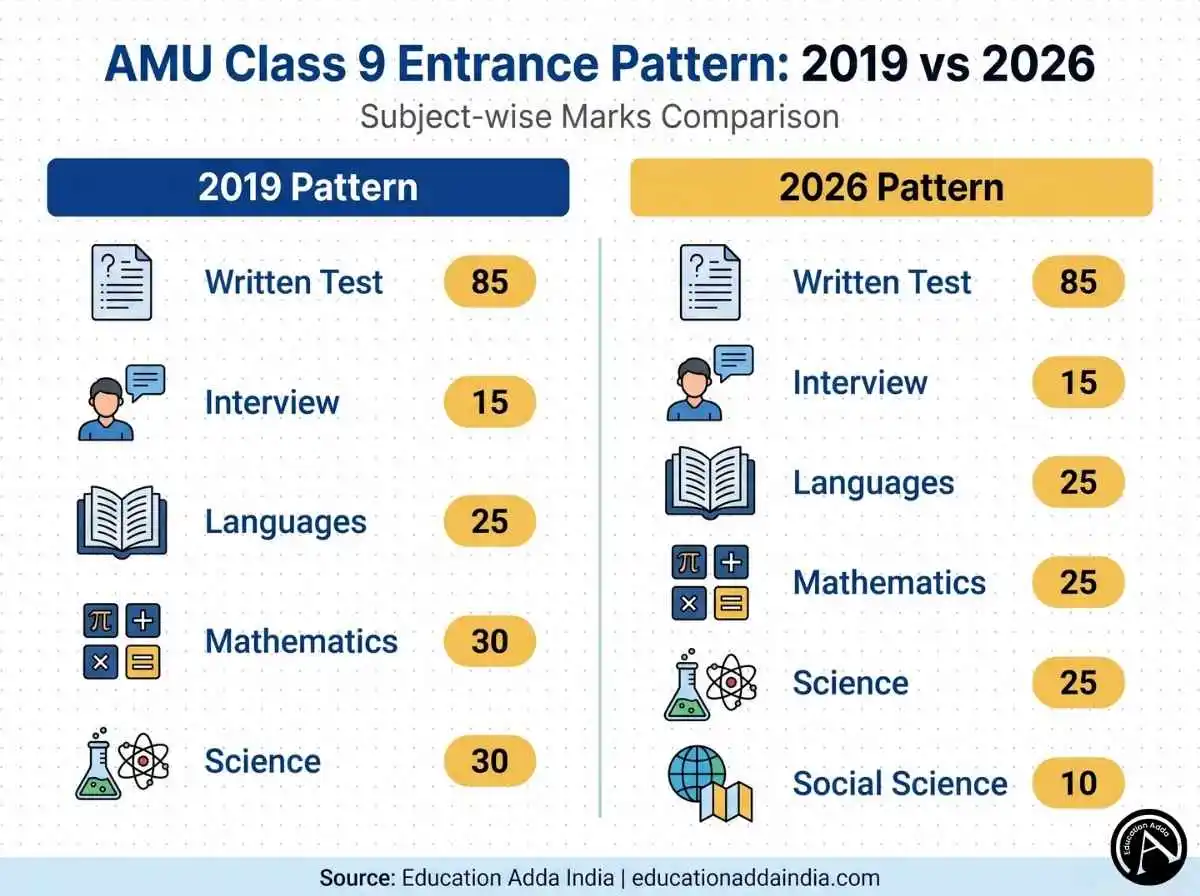
TL;DR — The AMU Class 9 entrance question paper 2019 followed an 85-mark written test plus 15-mark interview system. The 2019 written test had Section-I Languages 25 marks and Section-II Mathematics 30 + Science 30 marks. The latest 2026–27 guide keeps written test 85 + interview 15, but Section-II is now Mathematics 25, Science 25 and Social Science 10.
AMU Class 9 Entrance Question Paper 2019 PDF Practice Downloads
Download original 2019-style AMU Class 9 practice resources: full MCQ practice paper, answer key, OMR sheet, pattern checklist and error-log tracker. These are preparation resources and are not official AMU question papers.
| PDF Resource | Best For | Download |
|---|---|---|
| AMU Class 9 Entrance Question Paper 2019 Style Practice Set | 85-question 2019-style MCQ practice: Languages 25, Maths 30, Science 30 | Download PDF |
| AMU Class 9 2019 Style Answer Key and Solutions | Check answers after solving the practice paper | Download PDF |
| AMU Class 9 OMR Practice Sheet - 85 Questions | OMR speed and answer-marking accuracy | Download PDF |
| AMU Class 9 2019 vs 2026 Pattern Checklist | Understand old pattern vs latest Class IX pattern | Download PDF |
| AMU Class 9 Error Log and 14-Day Revision Tracker | Track mistakes, weak topics and retest dates | Download PDF |
AMU Class 9 Entrance Question Paper 2019: the quick answer
AMU Class 9 entrance question paper 2019 helps students understand the old Class IX exam pattern, OMR-based MCQ format, subject weightage and question difficulty. It should be used with the latest AMU guide because the current Class IX pattern includes Social Science in Section-II.
Students searching for AMU Class 9 entrance question paper 2019 usually want a PDF, answer key and clear pattern. The best way to use this paper is not just downloading it, but solving it like a real exam, checking mistakes, filling an error log and revising weak Class VIII topics.
The official AMU 2019–20 guide states that Class IX admission had a written test of 85 marks and interview of 15 marks. It also states that the 2019 Class IX written test had Section-I Languages of 25 MCQs and Section-II of 60 MCQs split into Mathematics 30 and Science 30.
Table of Contents
Official AMU Class 9 Entrance Exam Pattern 2019
| Component | Marks |
|---|---|
| Written Test | 85 |
| Interview | 15 |
| Total Merit | 100 |
2019 written test breakup
| Section | Subject | Questions | Marks |
|---|---|---|---|
| Section-I | Languages: English, Urdu and Hindi | 25 | 25 |
| Section-II | Mathematics | 30 | 30 |
| Section-II | Science | 30 | 30 |
| Total Written Test | 85 | 85 |
The official 2019–20 guide also says that the candidate must get a minimum of 40% marks in Section-I to be eligible for interview/admission, and the Class IX syllabus was the same as Class VIII CBSE/NCERT followed in AMU schools.
2019 vs Latest Pattern: What changed?
Students should not prepare only with the 2019 paper because the latest pattern has changed. The official 2026–27 AMU schools guide says Class IX still has written test 85 marks and interview 15 marks, but Section-II now includes Mathematics 25, Science 25 and Social Science 10.
| Area | 2019 Pattern | 2026–27 Pattern | What students should do |
|---|---|---|---|
| Written Test | 85 | 85 | Solve timed OMR mock tests |
| Interview | 15 | 15 | Prepare basic interview answers |
| Languages | 25 | 25 | Keep this section safe; 40% minimum matters |
| Mathematics | 30 | 25 | Revise Class VIII maths but adjust weightage |
| Science | 30 | 25 | Focus on NCERT Class VIII concepts |
| Social Science | Not in Section-II breakup | 10 | Add current-pattern Social Science practice |
Why the 2019 question paper is still useful
The 2019 paper is useful because it shows AMU’s MCQ style, speed requirement and Class VIII-level difficulty. However, it should be used as a pattern-learning resource, not as the only preparation source.
Use the 2019 paper for:
- understanding AMU question style,
- improving OMR speed,
- practising Languages, Maths and Science,
- checking time management,
- identifying weak topics,
- building an error log.
How to solve AMU Class 9 Entrance Question Paper 2019
Step 1: Solve it in one sitting
Set a 2-hour timer and solve the paper without checking the answer key.
Step 2: Use an OMR sheet
AMU guides mention OMR answer marking instructions and no negative marking in the 2019 guide. Use the OMR practice sheet provided above.
Step 3: Check answers honestly
Calculate section-wise marks, not only total marks.
Step 4: Fill the error log
Classify each mistake:
| Mistake type | Meaning | Fix |
|---|---|---|
| Concept mistake | Topic not clear | Revise NCERT Class VIII |
| Calculation mistake | Method right, calculation wrong | Timed practice |
| Reading mistake | Misread question/option | Slow down on keywords |
| Hurry mistake | Guessing or rushing | OMR discipline |
Step 5: Retest after 48 hours
Solve only the wrong questions again after revision.
Subject-wise preparation from 2019 paper
Languages
Focus on grammar, articles, prepositions, tenses, voice, narration, vocabulary, spelling and comprehension-style MCQs.
Mathematics
Important areas include linear equations, percentages, profit-loss, mensuration, geometry basics, squares/cubes, simple interest and data handling.
Science
Revise force and friction, sound, metals/non-metals, chemical effects, cell, reproduction, conservation, electricity basics and everyday science reasoning.
Social Science for current pattern
Even though Social Science was not part of the 2019 Section-II breakup, the latest Class IX pattern includes 10 marks of Social Science, so current students should also revise Class VIII History, Civics, Geography and basic Economics.
14-day preparation plan
| Day | Task |
|---|---|
| Day 1 | Solve 2019-style practice paper |
| Day 2 | Check answer key and fill error log |
| Day 3 | Revise Languages weak areas |
| Day 4 | Revise Maths percentages and equations |
| Day 5 | Revise Science force, friction and sound |
| Day 6 | Retest wrong questions |
| Day 7 | OMR practice + 30-minute mini mock |
| Day 8 | Revise mensuration and geometry |
| Day 9 | Revise cells, reproduction and materials |
| Day 10 | Add Social Science revision for latest pattern |
| Day 11 | Solve full mock |
| Day 12 | Analyse mistakes |
| Day 13 | Final weak-topic revision |
| Day 14 | Retest wrong questions |
Official AMU links students should check
| Need | Official Link |
|---|---|
| School admissions | AMU School Admissions |
| Guide to Admission Schools 2026-27 | Official AMU Schools Guide 2026-27 |
| Guide to Admission Schools 2019-20 | Official AMU Schools Guide 2019-20 |
| Answer keys | AMU Answer Keys |
FAQs
Where can I download AMU Class 9 entrance question paper 2019 PDF?
You can use legally available AMU question paper resources, official AMU pages where available, or original 2019-style practice PDFs. Do not copy copyrighted PDFs from Scribd or other competitors without permission.
What was the AMU Class 9 entrance pattern in 2019?
The 2019 Class IX written test was 85 marks and interview was 15 marks. The written test had Languages 25 marks, Mathematics 30 marks and Science 30 marks.
What is the current AMU Class 9 pattern?
For 2026–27, Class IX still has written test 85 marks and interview 15 marks. Section-I has Languages 25 marks, while Section-II includes Mathematics 25, Science 25 and Social Science 10.
Is the 2019 paper still useful?
Yes, but use it with the latest pattern. It is useful for MCQ style, OMR practice, time management and Class VIII-level concept revision.
Is there negative marking in AMU Class 9 entrance?
The 2019 AMU schools guide states that there shall be no negative marking in evaluation. Students should still verify the latest guide/admit card instructions.
Conclusion
The AMU Class 9 entrance question paper 2019 is still one of the best tools for entrance preparation because it shows the AMU question style and the speed needed to score. But candidates should adapt it using the latest official pattern, since current sessions include Social Science in Section-II. The winning method is simple: mock test → mistake sheet → NCERT topic fix → repeat until the score jumps.
Key Takeaways (Bullet Summary)
2019 Class IX written test: 85 marks + interview 15 marks.
2019 Section-II breakup: Math 30 + Science 30 (no Social Science).
Current (2026–27) Section-II breakup: Math 25 + Science 25 + Social Science 10.
Syllabus is Class VIII CBSE/NCERT level—NCERT books are the safest base.
Use PYQ the right way: timed test + mistake sheet + targeted revision.
For trusted updates, rely on Controller pages (answer keys, notices, guides)