 Md Arshad
AMU Class 11 Entrance Exam Sample Papers PDF 2026 Download PDF
Last updated: July 2026
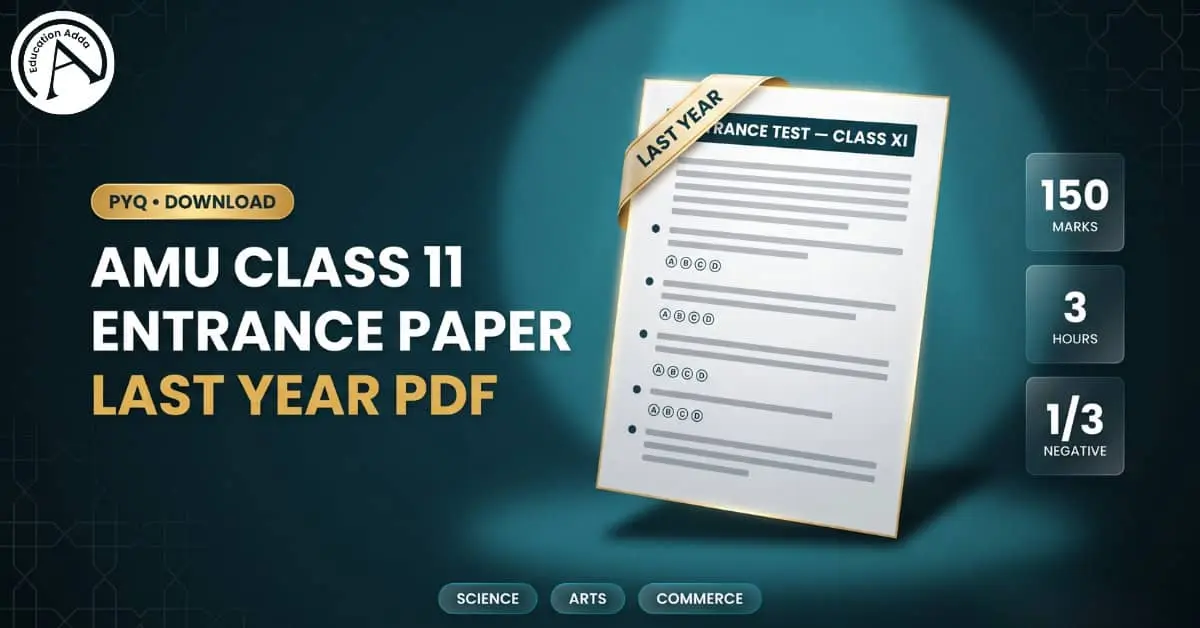
Quick Answer: AMU Class 11 entrance exam sample papers PDF help students practise objective-type questions, understand the real paper pattern, improve OMR speed, revise Class 9 and Class 10 concepts, and identify weak areas before the entrance test. For the best result, students should combine sample papers with AMU previous year question papers, official syllabus, answer keys, mock-test practice and error analysis.
Latest update — AMU’s official school admissions page lists Application Form 2026–27, Guide to Admission Schools 2026–27, Answer Keys and Admission Lists. AMU’s notice page also shows that Class XI Science / Humanities / Commerce admission test results for 2026–27 were declared on 14 May 2026, and counselling/admission schedule notice appeared on 11 June 2026. Students should always verify latest dates, answer keys and counselling updates from AMU Controller Exams before taking action.
AMU Class 11 Entrance Exam Sample Papers PDF Download
Download original AMU Class 11 practice PDFs for Science, Humanities/Commerce, GK, Indo-Islamic Culture, English, OMR practice and answer key. These PDFs are created for practice and preparation support.
| PDF Resource | Best For | Download |
|---|---|---|
| AMU Class 11 Science Full Mock Test 2026 | Full Science stream mock test practice | Download PDF |
| AMU Class 11 Humanities Commerce Mock Test 2026 | Humanities and Commerce stream practice | Download PDF |
| AMU Class 11 GK and IIC Practice Set 2026 | General Knowledge and Indo-Islamic Culture revision | Download PDF |
| AMU Class 11 English Practice Set 2026 | English grammar, vocabulary and comprehension practice | Download PDF |
| AMU Class 11 OMR Practice Sheet 2026 | OMR marking speed and accuracy practice | Download PDF |
| AMU Class 11 Practice Answer Key 2026 | Check answers after solving practice PDFs | Download PDF |
Table of Contents
AMU Class 11 Entrance Exam Sample Papers: the quick answer
AMU Class 11 entrance exam sample papers are practice papers designed to help students understand the MCQ format, syllabus coverage, time management and question difficulty before the admission test. Students should use them with previous year papers, official AMU syllabus, answer keys and timed mock-test practice.
If you are preparing for AMU Class 11 admission, downloading PDFs is only the first step. The real improvement comes when you solve sample papers in exam conditions and analyse every mistake. AMU Class 11 entrance is not just about reading more chapters; it is about solving the right questions, improving speed, avoiding silly mistakes and understanding which topics appear again and again.
For Science Stream, AMU’s official syllabus document says the selection is based on an objective-type multiple-choice paper of 100 marks and 100 questions. The same document also says the test is based on AMU’s Secondary School Certificate Examination syllabus for Class IX and X and is almost similar to CBSE/NCERT level.


AMU Distance Education 2026: Admission, Last Date, Courses List, Fees, Eligibility
AMU Class 11 Previous Year Papers vs Sample Papers
Students often confuse sample papers with previous year papers. Both are useful, but their purpose is different.
| Type | Meaning | Best time to use |
|---|---|---|
| Sample Paper | Practice paper based on expected pattern | During regular preparation |
| Previous Year Paper / PYQ | Actual paper from past entrance exams | After syllabus revision |
| Mock Test | Full test simulation | Final 30–45 days |
| Answer Key | Correct option list | After solving each paper |
| OMR Sheet | Answer marking practice | Weekly practice |
Academistan ranks well because it clearly organises AMU entrance previous year papers by class and stream, including Class 11 Science, Arts and Commerce categories. It also positions PYQs as actual questions from past entrance exams and says answers/online tests are available.
SelfStudys also covers year-wise AMU previous year papers and says it provides papers from 2005 to 2024, which shows that Google is rewarding pages that offer broad year-wise coverage, not just a single sample paper.
Official AMU Class 11 Science Exam Pattern
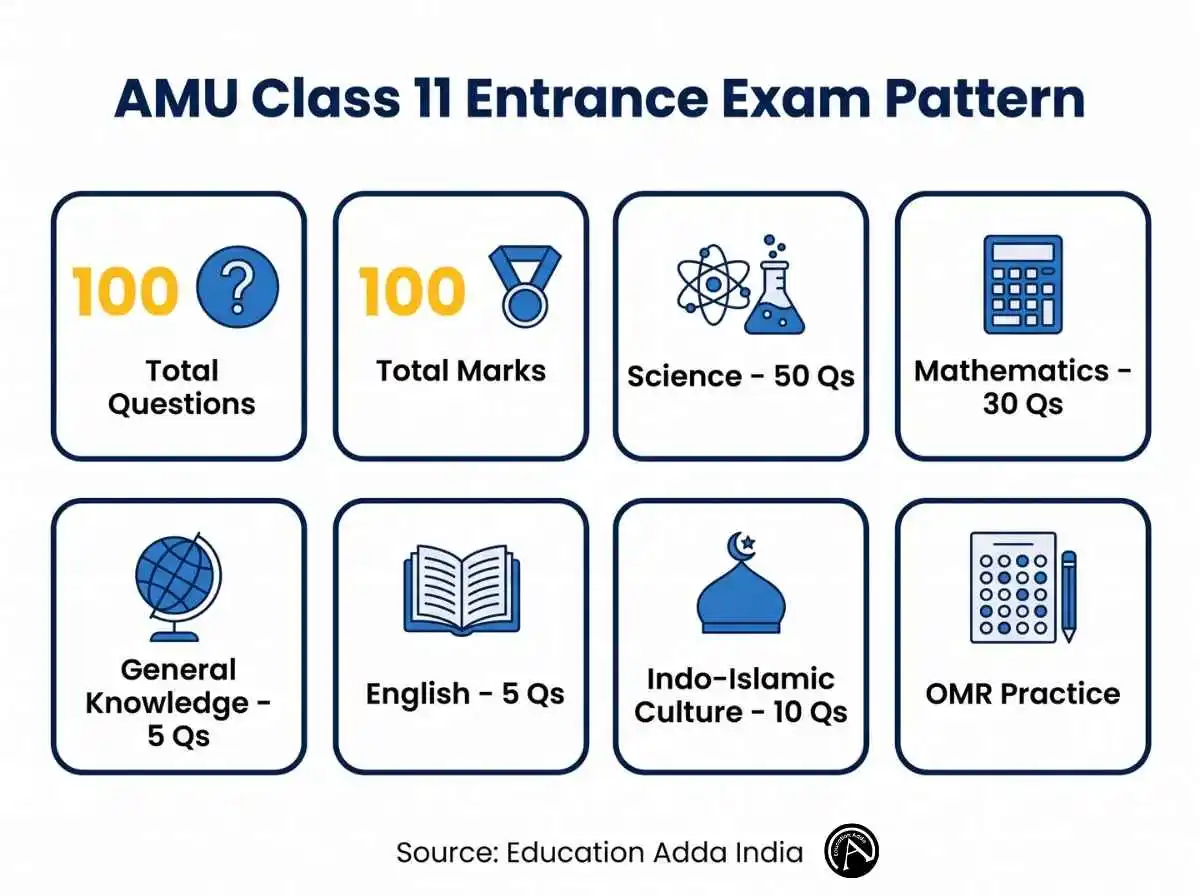
AMU’s official Class XI Science syllabus mentions one objective-type paper of 100 marks comprising 100 questions. The official breakup is:
| Section | Marks |
|---|---|
| Science: Physics, Chemistry and Life Science | 50 |
| Mathematics | 30 |
| General Knowledge | 5 |
| English | 5 |
| Indo-Islamic Culture | 10 |
| Total | 100 |
This is one of the most important sections of the article because many third-party pages show outdated or mixed patterns. Always cross-check with the latest AMU Controller Exams notice or syllabus before the exam. The official Science syllabus also says the paper is available in English, Hindi and Urdu, and the level is based on Class IX and X syllabus, almost similar to CBSE/NCERT
Official AMU Class 11 Humanities and Commerce Exam Pattern
| Section | Marks |
|---|---|
| Social Studies: Civics, Economics, History and Geography | 60 |
| Mathematics | 20 |
| General Knowledge | 5 |
| English | 5 |
| Indo-Islamic Culture | 10 |
| Total | 100 |
For Humanities and Commerce Stream, AMU’s official syllabus PDF says the admission test is objective-type and includes these subjects:
| Subject group | Included areas |
|---|---|
| Social Studies | Civics, Economics, History and Geography |
| Mathematics | Class 9–10 level basics |
| General Knowledge | Static + current awareness |
| Indo-Islamic Culture | AMU-specific scoring area |
The Humanities/Commerce syllabus also states that the question booklet is available in three languages: English, Hindi and Urdu.
AMU Class 11 Syllabus: what to study before solving papers
Before solving full sample papers, students should complete the basic syllabus. Otherwise, sample papers become guesswork.
Science Stream
Focus on Class 9 and Class 10 level concepts from:
- Physics
- Chemistry
- Life Science / Biology
- Mathematics
- General Knowledge
- English
- Indo-Islamic Culture
The official Science syllabus lists Physics topics such as motion, force and Newton’s laws, gravitation, work-energy-power, flotation, sound, electricity and related concepts.
Humanities and Commerce Stream
Focus on:
- Civics
- Economics
- History
- Geography
- Mathematics
- General Knowledge
- Indo-Islamic Culture
For Humanities/Commerce, Social Studies becomes very important because the official syllabus includes Civics, Economics, History and Geography.
How to use AMU Class 11 sample papers effectively
Step 1: Do not solve papers casually
Take every sample paper like a real exam. Sit in a quiet place, set a timer, keep your phone away and mark answers in one attempt.
Step 2: Use an OMR-style answer sheet
Even if you know the answer, OMR marking mistakes can reduce your score. Practice filling bubbles correctly, especially in the last 15 minutes.
Step 3: Check your paper honestly
After solving the paper, check every answer. Do not just calculate marks. Identify why you made the mistake.
Step 4: Make an error log
| Question No. | Subject | Mistake type | Reason | Fix |
|---|---|---|---|---|
| Q12 | Physics | Concept mistake | Formula not clear | Revise motion chapter |
| Q25 | Maths | Calculation mistake | Speed pressure | Practice 20 MCQs |
| Q43 | Chemistry | Memory mistake | Reaction not revised | Make short notes |
| Q70 | GK | Weak recall | No daily revision | 10-minute GK routine |
| Q88 | English | Grammar mistake | Rule confusion | Revise tense/preposition |
Step 5: Retest wrong questions after 48 hours
This is where most students improve. Do not just read the solution. Solve the wrong question again after 2 days.
30-day, 60-day and 90-day preparation plan
30-day plan
| Days | Task |
|---|---|
| Day 1–5 | Revise Science / Social Studies basics |
| Day 6–10 | Revise Mathematics |
| Day 11–15 | Solve subject-wise MCQs |
| Day 16–20 | Solve 3 full sample papers |
| Day 21–25 | Analyse mistakes and revise weak topics |
| Day 26–30 | Solve PYQs + OMR practice + final revision |
60-day plan
| Phase | Task |
|---|---|
| Day 1–20 | Complete Class 9 and 10 syllabus basics |
| Day 21–40 | Solve subject-wise practice sets |
| Day 41–55 | Solve full sample papers and PYQs |
| Day 56–60 | Revise error log and important formulas |
90-day plan
| Month | Task |
|---|---|
| Month 1 | Build concepts from Class 9 and 10 |
| Month 2 | Solve topic-wise MCQs and sample papers |
| Month 3 | Solve PYQs, mock tests, answer keys and OMR practice |
AMU Class 11 Mock Test Score Tracker
Enter your section-wise marks and estimate your preparation level.
Common mistakes students make
The biggest mistake is downloading many PDFs but not solving them properly. A student who solves 5 papers with full analysis can improve more than a student who downloads 30 PDFs but never checks mistakes.
Second mistake is ignoring the official syllabus. AMU’s official Science syllabus clearly mentions the subject breakup and the Class IX–X base level. So, do not rely only on coaching notes or random PDFs.
Third mistake is ignoring small scoring sections like GK, English and Indo-Islamic Culture. These sections look small, but they can create a difference in final merit.
Fourth mistake is not practising OMR-style marking. In objective exams, speed and answer marking are part of performance.
Official AMU links students should check
| Need | Where to check |
|---|---|
| Application form | AMU Controller Exams school admissions page |
| Guide to Admission Schools | AMU Controller Exams school admissions page |
| Answer keys | AMU official answer key section |
| Admission lists | AMU official admission lists section |
| Notices and counselling | AMU Controller Exams notices page |
| Official syllabus | AMU syllabus PDFs / AMU Controller Exams resources |
The AMU school admissions page lists Application Form 2026–27, Guide to Admission Schools 2026–27, Answer Keys and Admission Lists in one place.
About this guide
Key takeaways
- AMU Class 11 sample papers are useful when solved in real exam conditions.
- The Science Stream official pattern mentions 100 marks and 100 questions.
- Science has 50 marks, Mathematics 30, GK 5, English 5 and Indo-Islamic Culture 10.
- Humanities/Commerce includes Social Studies, Mathematics, GK and Indo-Islamic Culture.
FAQ
Where can I download AMU Class 11 entrance exam sample papers PDF?
You can download AMU Class 11 sample papers from trusted education websites, official AMU resources where available, and properly organised previous year paper repositories. Always check stream, year, paper type and answer key before using any PDF.
What is the AMU Class 11 Science exam pattern?
The official AMU Class XI Science syllabus mentions one objective-type paper of 100 marks with 100 questions. The breakup is Science 50 marks, Mathematics 30 marks, General Knowledge 5 marks, English 5 marks and Indo-Islamic Culture 10 marks.
Is AMU Class 11 entrance based on Class 9 and 10 syllabus?
Yes. AMU’s official Science syllabus says the admission test is based on the syllabus prescribed for AMU Secondary School Certificate Examination, Class IX and X, and is almost similar to CBSE/NCERT level.
Which subjects are included in AMU Class 11 Humanities and Commerce entrance?
The official Humanities/Commerce syllabus includes Social Studies, Mathematics, General Knowledge and Indo-Islamic Culture. Social Studies includes Civics, Economics, History and Geography.
Are AMU Class 11 previous year papers better than sample papers?
Previous year papers are better for understanding real exam trends, while sample papers are better for regular practice. The best strategy is to use both.
How many AMU Class 11 sample papers should I solve?
Students should solve at least 10–15 full papers before the exam, but quality matters more than quantity. Every paper should be followed by checking, error logging and retesting.
Should I practise with an OMR sheet?
Yes. OMR practice improves speed, accuracy and answer marking discipline. It also reduces mistakes during the actual entrance test.
Where should I check official AMU updates?
Check AMU Controller Exams pages for application forms, admission guide, answer keys, admission lists, notices and counselling schedules.
Pro tip 1: Put the PDF download table in the first 25% of the article. This matches the main search intent.
Pro tip 2: Add separate buttons for Science, Humanities, Commerce, GK, English and Indo-Islamic Culture practice sets.
Pro tip 3: Create your own original “AMU Class 11 Mock Test PDF” with answer key. This can attract backlinks and repeat visits.
Warning 1: Do not copy copyrighted PDFs from competitors.
Warning 2: Do not show outdated marks distribution without checking the official syllabus.
Warning 3: Do not claim “official sample paper” unless the PDF is actually from AMU.
Insider tip: Add one downloadable OMR sheet and one score tracker tool. These small resources can increase dwell time, shares and return visits.
Conclusion
AMU Class 11 entrance exam sample papers PDF can improve your preparation only when you use them with a clear method. First understand the official pattern, then complete the Class 9 and 10 level syllabus, solve papers with a timer, practise OMR marking, check answers and maintain an error log. Students who revise mistakes repeatedly improve faster than students who only collect PDFs.