 sarfarosheamanager
 Key Differences Between CBSE vs State Board
Choosing the right educational board in India can significantly shape a student’s academic journey and future opportunities. The Central Board of Secondary Education (CBSE) and the various state board systems are two major options, each with distinct curricula and evaluation methods.
This comprehensive comparison of CBSE vs State Board will highlight their key differences, pros and cons, and help you determine which board is a better fit for your child’s needs. Read on to understand how these boards differ in syllabus, exams, language, and focus – and why this article is worth reading for every parent and student making this crucial decision.
Table of Contents
Google AI Overview: CBSE vs State Board at a Glance
CBSE vs State Board – CBSE is a national education board in India with a standardized curriculum across the country, whereas state boards are administered by individual state governments with syllabi that vary from state to state. CBSE’s uniform curriculum (set by NCERT) prepares students for national-level board exams and competitive tests like JEE/NEET, while state boards focus on regional language and content relevant to the respective state.
The choice between them depends on the student’s future career goals, mobility (CBSE is advantageous for transfers), and learning preferences. In short, CBSE offers consistency and national recognition, whereas a state board provides localized learning and may be easier in terms of pressure, but could require extra effort for all-India exams.
Understanding CBSE and State Boards
CBSE (Central Board of Secondary Education) is a national-level board of education in India, managed by the central government. It is known for a uniform and standardized curriculum that is followed by thousands of CBSE schools across the country. CBSE follows a structured syllabus designed by NCERT, emphasizing conceptual understanding and consistency in teaching standards.
It conducts national-level board exams (the All India Secondary School Examination for Class 10 and the Senior School Certificate Examination for Class 12) that are the same across India. With nearly 32,000 schools affiliated to CBSE, it has a wide presence nationally and even abroad. This national education board in India ensures that CBSE students in different states learn from the same textbooks and are evaluated on equal benchmarks.
On the other hand, state boards refer to the education boards run by each state’s education department. Every state (and union territory) has its own board – for example, Maharashtra State Board, Tamil Nadu State Board, Uttar Pradesh Board, etc. – which designs the syllabus and conducts exams primarily within the respective state.
There are 52 state-sanctioned boards in India catering to specific regional needs. Each state board syllabus is unique, often incorporating local history, language (such as Hindi or Tamil), and culture, which means curricula vary from state to state.
State boards are managed by the state government’s education department, and their exams and certificates are officially recognized within the state (and of course valid for higher studies nationally, but the content is state-specific). Because state board education is localized, transferring from one state’s board to another can be challenging due to syllabus differences. However, these boards make up the bulk of India’s schools – collectively, state boards have far more schools and students than CBSE does.
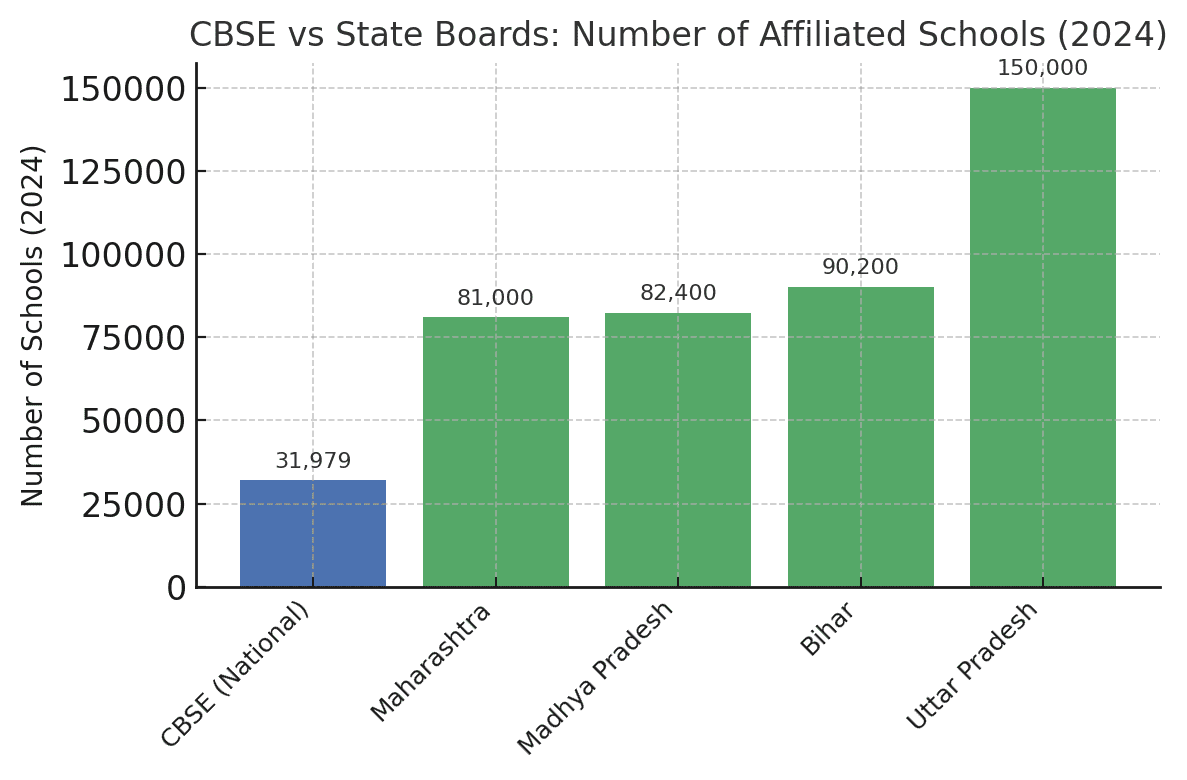
Figure: CBSE vs State Boards – Number of Affiliated Schools (2024). The blue bar (left) shows CBSE’s ~31,979 affiliated schools nationwide. Green bars (right) show examples of individual state boards: Maharashtra (~81,000 schools), Madhya Pradesh (~82,400), Bihar (~90,200), and Uttar Pradesh (~150,000 schools) in 2024.
Recognition and scope: A key distinction in CBSE and state board systems is their sphere of recognition. CBSE is a national board, so a certificate from CBSE is recognized all over India (and even internationally) without question. State boards are recognized as well, but the curriculum is tailored for higher education within the state.
For instance, a student graduating from Maharashtra State Board will easily meet local college requirements, and the content might align with state-level entrance exams or reservation criteria in that state. However, CBSE’s standardized content can make it easier when applying to central universities or moving across states. Both CBSE and state board qualifications are accepted for college admissions, but CBSE students might have an edge in national-level competitive exams, which we’ll discuss later.
Language of instruction: Most CBSE schools use English (and/or Hindi) as the medium of instruction, aligning with its national character. In contrast, state board schools often teach in the state’s regional language (e.g., Marathi in Maharashtra, Tamil in Tamil Nadu, Hindi in many Hindi-speaking states), though many offer English medium sections as well.
This means students in state boards can study in their mother tongue which may improve understanding of concepts in early years. CBSE does allow Hindi and other languages as mediums too, but it is commonly associated with English-medium education across India. (It’s notable that people even search for cbse vs state board in hindi to find information in Hindi – reflecting the importance of language in this decision.)
Structure and administration: The board of education governance also differs. CBSE is centrally administered and has a unified approach – CBSE follows a uniform set of academic guidelines and exam schedule nationwide. State boards are decentralized; each state board follows the directives of its state’s education department, leading to differences in academic calendars, marking schemes, and even pass marks.
This flexibility means state boards can adapt to local needs (for example, adjusting curriculum difficulty or content relevant to the state’s context), but it also means quality and rigor can vary from state to state. Some state boards often update their syllabus at their own pace, which may lag behind or ahead of national standards.
Key Differences Between CBSE and State Board
When comparing CBSE vs state board, there are several key differences to consider. These differences span curriculum content, exam patterns, difficulty level, and beyond. Below we break down the major points of comparison:
Curriculum and Syllabus
CBSE curriculum: The CBSE syllabus is centralized and designed by NCERT (National Council of Educational Research and Training). CBSE’s curriculum is known for being concept-driven and standardized across all CBSE-affiliated schools. It emphasizes core subjects (Math, Science, Social Science, Languages) with a balance of theory and application. The CBSE curriculum is designed to ensure that students from any region receive the same content depth and breadth.
This uniformity helps prepare students for national level tests since CBSE follows a structured progression in topics and focuses on building fundamentals. Notably, CBSE offers a standardized curriculum that is regularly updated and is generally aligned with competitive exam syllabi. CBSE schools use NCERT textbooks, and as of mid-2020s even many state boards have started adopting NCERT books (about 23 states use NCERT books in their curriculum). This adoption shows a trend toward uniform content, though implementation still varies.
State board syllabus: Each state board designs its own syllabus catering to regional contexts. State board curriculum often includes more localized content – for instance, state history, geography, and regional literature find greater emphasis. The syllabus of state board schools can differ significantly from CBSE, both in topics covered and the difficulty depth. Some state boards might have comparatively fewer chapters in a subject than CBSE or cover them in a different sequence.
Importantly, state board syllabus varies with the state: a science textbook in Tamil Nadu State Board might not be identical to one in Karnataka’s board. Generally, state syllabi are considered slightly less exhaustive than CBSE at the higher secondary level (11th–12th), but this is a broad generalization.
The trade-off is that state syllabi might be easier to manage for average students, but could lack some of the advanced topics that CBSE includes for competitive exam readiness. Still, several state boards may offer elective subjects or additional language papers specific to the state’s culture. In summary, CBSE’s syllabus is uniform and national-level, whereas state boards’ syllabi are diverse and primarily within the respective state context.
Examination Pattern and Evaluation
CBSE board exams: CBSE conducts national-level board exams for Class 10 and 12 simultaneously across all CBSE schools. These exams use a common question paper and marking scheme, ensuring that evaluation is uniform. The question papers often include a mix of objective questions (like MCQs) and descriptive questions, testing understanding and application.
CBSE conducts the All India Secondary School Examination (for 10th) and Senior School Certificate Examination (12th) each year with a well-defined structure. The evaluation is centralized to an extent – answer sheets are evaluated based on CBSE’s marking guidelines by examiners who are trained to follow the scheme. This means a student in Delhi and a student in Tamil Nadu taking CBSE exams are graded on the same criteria.
The board exams are known to be moderate in difficulty but thorough in coverage. CBSE also uses a grading system (like A1, A2, etc.) for results, and continuous assessment (projects, internal assessment) contributes to final scores in some subjects. Overall, CBSE prepares students with an exam pattern that encourages analytical thinking over rote memorization.
State board exams: State board examinations are conducted separately by each state’s board, usually for Class 10 (Secondary) and Class 12 (Higher Secondary). The pattern of exams varies among state boards – some may follow the traditional long-form exam papers for 100% of the score, while others incorporate internal marks for practicals or projects. Generally, state board exams tend to focus more on content mastery as per the textbook, sometimes with more direct questions.
The difficulty level can differ: certain state boards are considered relatively easy to score in, whereas a few (like some southern boards) are known for stringent marking. State boards often use the local language in question papers (alongside English in many cases). The evaluation criteria are set by the state – e.g., some boards might be lenient to ensure higher pass rates, while others might be stricter.
There is also variation in grading: a few state boards have adopted grading similar to CBSE, but many still declare raw percentages or division classifications. Because of these disparities, results can’t be directly equated across states. According to a 2024 analysis by India’s Ministry of Education, state boards have higher failure rates on average than central boards – for instance, in 2023 the Class 10 failure rate in state boards was about 16%, compared to only 6% in the central boards (like CBSE).
This could reflect differences in evaluation standards and student support systems. To summarize, CBSE’s exam system is uniformly implemented with a mix of question types, whereas each state board exam follows its own pattern, often more rote-oriented, and evaluation standards can differ widely.
Medium of Instruction and Language
Language plays a big role in the differences between CBSE and state boards. CBSE follows a uniform policy where English (and Hindi) are the main mediums of instruction in its schools. Most CBSE board schools, especially private ones, teach in English, with Hindi or other Indian languages offered as subjects or optional medium in some schools (e.g., Kendriya Vidyalayas offer bilingual teaching). This English-medium focus of CBSE can benefit students aiming for national institutes where entrance exams are in English, and it often improves English proficiency.
State boards, in contrast, mostly operate in the regional language of the state (along with English as a subject or optional medium). For example, Tamil Nadu State Board schools predominantly teach in Tamil (with English taught alongside), Maharashtra State Board schools may use Marathi or a mix of Marathi and English, and so on. This approach ensures education is accessible and culturally relevant, allowing students to learn complex subjects in their mother tongue. It can be an advantage for grasping foundational concepts early on.
However, one potential drawback is that students from vernacular medium might need to adjust if they pursue higher education in English later. CBSE students often have an easier transition to English-language universities. That said, many state board schools now also offer English-medium sections due to demand. Ultimately, state board provides strength in regional language and context, whereas CBSE emphasizes a pan-Indian medium (with English/Hindi), aligning with national-level academic and professional environments.
Academic Rigor and Difficulty Level
A common question is whether CBSE or state board is tougher. The answer isn’t straightforward – difficulty varies by subject and by state. CBSE curriculum ensures a certain level of rigor; it introduces advanced concepts, especially in science and math, by higher classes. The questions in CBSE exams often test understanding rather than just recall, which some students find challenging. On the other hand, many state boards mostly focus on textbook knowledge and can be more straightforward, which might appear “easier.”
In terms of syllabus volume, CBSE’s content can be more extensive in some subjects. State boards may trim or simplify content to suit their student demographics – for example, a state board might omit some chapters that CBSE includes, or vice versa, depending on educational priorities. However, “easier” doesn’t always mean “better results.” We saw that state boards actually had higher failure rates on average, possibly due to disparities in teaching quality or resources. In some states, top students find the state syllabus challenging enough and perform excellently, but average students might cope better due to familiar language and context.
Compared to CBSE, state board exams might have predictable question patterns (making high scores achievable with thorough rote preparation). CBSE’s national papers can spring surprises, testing true understanding. Educators often note that students from CBSE might develop stronger analytical skills, while state board students might excel in rote memory and detailed writing. In essence, CBSE is often perceived as tougher in academics, but certain state boards (and definitely ICSE board, discussed later) can be as challenging. The key differences between CBSE and state boards in difficulty largely come down to teaching approach and depth of content rather than inherent toughness of one vs the other.
Flexibility and Curriculum Update
CBSE offers consistency but less flexibility to deviate from the set curriculum. All CBSE schools must adhere to the NCERT curriculum and cannot easily incorporate state-specific topics beyond what’s in the syllabus. This means CBSE students nationwide miss out on in-depth regional studies during school (though NCERT includes some regional examples). Meanwhile, state boards often have the flexibility to include chapters relevant to local culture, important state personalities, regional geography etc., giving a sense of identity in the curriculum.
They also have freedom to introduce new subjects (like a state might introduce a compulsory Ethics paper or local language literature as mandatory, which CBSE doesn’t have beyond optional language courses). On updating curriculum: CBSE usually updates gradually in line with national education policy and NCERT revisions. State boards may rapidly implement changes or, conversely, may not update syllabi for years due to administrative reasons.
This can result in some state board textbooks being outdated compared to CBSE’s. However, with the National Education Policy and general trends, many state boards are modernizing their content. For example, as noted, many states now use NCERT textbooks for science/math to keep parity. Still, choosing the right board sometimes depends on whether you value a tried-and-true national syllabus or a more locally adaptive one.
Transfer and Mobility
One practical consideration is the ease of switching schools or boards. CBSE is a national board, so if parents have transferable jobs across India, CBSE is usually recommended. A CBSE student can move from one city to another and join another CBSE school without major academic disruption because the syllabus and books will be the same.
In contrast, a student studying in a state board is somewhat tied to that state – if they move to a different state, the syllabus, language, and textbooks will all change under the new state board, which can be a big adjustment. While switching from state board to CBSE or vice-versa is possible (for example, some students switch to CBSE at Class 11 after doing state board till Class 10, or some switch to state board to take advantage of perceived easier marking in 12th), it requires catching up on different content.
Deciding between CBSE and state board should factor in how likely the student is to relocate or aim for colleges outside their home state. If high mobility is expected, CBSE clearly has the edge. However, if the student will likely pursue higher education within their state, a state board can suffice and might even align better with state entrance exams or reservation criteria.
Competitive Exams and Future Career Opportunities
A major point in the CBSE vs State Board differences debate is the preparation for competitive entrance exams (like JEE, NEET, UPSC, etc.) and the impact on career opportunities. CBSE curriculum offers a strong foundation for competitive exam preparation. Since exams like JEE (for engineering) and NEET (for medical) are based largely on the NCERT syllabus (which is what CBSE uses), students from CBSE often find the content familiar when they start exam coaching. In fact, CBSE’s focus on conceptual clarity, problem-solving, and application in science and math directly helps in these exams.
They are better prepared for competitive exams by default of their school learning. It’s telling that the top ranks in all-India exams have a good representation of CBSE school alumni, partly because of this alignment (and also because many top schools that produce such rankers are CBSE-affiliated). That said, state board students can and do crack competitive exams too – they might just need additional effort to cover any gaps. Often, students from state boards enroll in parallel coaching classes to learn the NCERT topics not covered in their board, especially in Class 11–12.
For example, a student from a state board in Tamil Nadu might join a JEE coaching center that essentially teaches the CBSE curriculum in the relevant subjects to ensure no topic is missed. So it’s certainly possible for state board students to succeed nationally, but they must be proactive. For exams like UPSC Civil Services, having studied under any board doesn’t directly matter, but English medium comfort (which CBSE encourages) can help in some stages of those exams.
When it comes to higher education admissions: whether CBSE or state board, Indian colleges accept both. However, some elite national institutions (IITs, central universities, AIIMS, etc.) use entrance exams where, as noted, CBSE alignment is beneficial. State universities often reserve a percentage of seats for state board toppers or have normalization systems. If a student’s goal is to attend a local college or state engineering/medical college, doing well in the state board exams could actually be very useful – in some states, board exam marks are a criterion for college admission (e.g., state counseling ranks).
Also, professional courses like law or accounting that have entrance tests are open fields. There’s a perception that CBSE is better for a future career in fields like engineering/medicine due to the competitive exam edge. This is generally true, but only because of synergy in syllabus; a dedicated student from any board can catch up with extra effort. For careers in state government services or local professions, state board background can even be an advantage because of familiarity with local language and context.
In summary, choosing the right board depends on the student’s career trajectory: CBSE prepares students for national and international opportunities with its uniform standards, while state board education might cater well to careers rooted in the state (like state civil services exams, which sometimes include local language or state-specific knowledge).
Infrastructure and Resources
Another difference that often comes up is the availability of resources and quality of schools. Many of the reputed private schools in cities opt for CBSE affiliation. CBSE also has many national-level schools like Kendriya Vidyalayas and Navodaya Vidyalayas, which are well-resourced. As a result, a CBSE school on average might have better infrastructure (science labs, libraries, extracurriculars) than an average state board school, especially in rural areas. State board schools include a vast network of government schools which provide affordable education but sometimes struggle with resources and student-teacher ratios.
Of course, there are excellent state board schools (including prestigious old institutions in each state, as well as many state-board affiliated private schools) that provide quality education. But when considering the overall ecosystem, parents often feel CBSE schools have an advantage in teaching methodology training, because CBSE as a board conducts teacher workshops and has standardized teaching guidelines. State boards leave pedagogy to schools, which can lead to variations. The board offers a framework, but implementation depends on the school. If you have access to a top-tier state board school, the difference in outcome might be negligible.
However, in many cases, CBSE schools leverage the national curriculum to bring in innovative teaching (activity-based learning as guided by NCERT). In terms of study materials, CBSE students benefit from a plethora of guidebooks, reference materials, and CBSE also provides sample papers every year. For state boards, material is mostly available in the local language and might not be as extensive (though this is improving with the internet). Thus, state boards may offer less external resource support simply due to scale and language, whereas CBSE’s resources are abundant countrywide.
IGCSE vs CBSE: A Simple Guide to Choosing the Best Board for Your Child (2026)

The Ultimate Guide to CBSE Test Generators: Make Question Papers Fast (2026)

Choosing Humanities Subjects in 11th CBSE: A Complete Guide for You
Pros and Cons: CBSE vs State Board
Both CBSE and state boards have their own advantages and disadvantages. Let’s outline some of the key differences between CBSE and state boards in terms of pros/cons for students and parents:
Advantages of CBSE Board
Uniform Curriculum Nationwide: The biggest advantage of CBSE is its uniform syllabus across India. This is ideal for families that relocate frequently, as the student won’t have to grapple with a new syllabus in a new state. The CBSE curriculum ensures consistency in learning outcomes.
Focus on Concepts and Competitive Exams: CBSE curriculum is designed to build conceptual clarity. As a result, CBSE students often find themselves better prepared for competitive exams like JEE/NEET which draw heavily from NCERT content. The board’s emphasis on application and problem-solving from early classes builds a strong foundation for these exams.
National and International Recognition: Being a national education board in India, CBSE is widely recognized by all colleges in India and many abroad. A good performance in CBSE board exams is seen as credible anywhere. It is also easier for CBSE students to apply to central institutes (many of which require CBSE or equivalent) and foreign universities since they can provide standardized transcripts in English.
Resource Availability: CBSE has abundant study materials, reference books, and sample papers available. Many online platforms cater to CBSE syllabus. Additionally, CBSE’s recommended textbooks (NCERT books) are known for their quality and are even used by some international boards for reference. This ensures that a student has access to the best CBSE guides and does not run out of practice resources.
Holistic Approach and Co-curriculars: CBSE encourages a holistic education. It offers a range of subjects and vocational courses. Continuous and Comprehensive Evaluation (CCE) was introduced (and evolved) in CBSE to reduce exam stress and promote co-curricular activities. Many CBSE board schools thus focus on sports, arts, and life skills in addition to academics.
Advantages of State Board
Localized and Culturally Relevant Education: State board provides education that is closely tied to the state’s culture, history, and language. Students develop a strong grounding in their regional environment – e.g., they might study their state’s history in-depth or literature in their mother tongue. This can foster a strong identity and comfort in the local context, which is beneficial if they continue higher education within the state or work in fields related to regional development.
Easier Curriculum (in some cases): Many perceive state board is a better choice for students who prefer a less pressurized environment. Often, state board students face board exams that are more predictable and arguably “easier” in terms of direct questions. The pace of syllabus coverage might be tuned to average students in that state, making it less intensive than CBSE for some. This can reduce stress and allow more time for other interests during school years.
Language Advantage: Students studying in their respective state language (like Marathi, Tamil, Telugu, etc.) achieve a high level of proficiency in it, which CBSE students (with mostly English medium) might not. This is an advantage in state-level professional exams or jobs that require knowledge of the local language (for example, state civil services, local administrative jobs, or careers in the arts and public service in the state). Additionally, learning in one’s mother tongue can improve comprehension in early education, as many educational experts advocate.
Cost and Accessibility: Most government-run schools and many affordable private schools in a state follow the state board. This makes state board education accessible to a large population at minimal cost. It’s inclusive of rural and urban students alike. By contrast, many CBSE schools are private and have higher fees. If quality education at a low cost is the priority, a good state government school or aided school in the state board system can be the best route. Also, these schools are widespread – every taluka or district in a state will have a state board school, whereas CBSE schools might be fewer in number outside cities.
State Exam Opportunities: In states like Maharashtra or Tamil Nadu, the state boards are recognized for producing toppers who excel in state engineering/medical entrance exams or get admissions in state universities (some of which allocate significant weightage to board exam marks). For instance, certain states had policies (at least historically) where medical college seats were filled by state board exam toppers. State board students might focus on excelling in that sphere, which can directly secure their future career path within the state’s education system.
Disadvantages and Considerations
While the pros are significant, there are trade-offs:
CBSE Disadvantages: The CBSE board’s rigorous curriculum can be challenging for some students. Not every child thrives in a highly standardized, exam-focused environment. The pressure of all-India competition might be intense in CBSE schools. Additionally, CBSE schools can be more expensive on average, and in areas where they are scarce, students may have to travel far or stay in hostels to attend one. Another point is that CBSE’s focus on national curriculum means a student might lack deeper knowledge of their own state’s history/culture compared to a state board peer – they might need to self-study those if interested or if needed for exams like state civics or heritage quizzes.
State Board Disadvantages: State board students might face a disadvantage when competing at the national level. They often have to put extra effort to align with the NCERT standard for entrances. The transition to English-medium higher studies can be a hurdle if they were in a vernacular medium. Quality of education in state board schools can be inconsistent – some schools may not cover the full syllabus on time due to resource constraints, requiring students to seek outside tuition.
Furthermore, if a student decides later to apply out-of-state or abroad, they may find CBSE students have had exposure to a broader perspective in some subjects. The state boards mostly operate independently, so a very unique topic taught in one state’s syllabus might not carry relevance elsewhere. Recognition isn’t an issue within India, but abroad, admissions offices are more familiar with CBSE or ICSE, so you might have to provide extra context for a state board transcript.
In essence, neither is absolutely “better” in all aspects – it depends on the context of the student. If aiming for national-level board exams excellence and all-India opportunities, CBSE has an edge. If looking for a comfortable, locally relevant education that might be a better fit for certain learning styles or financial situations, state boards shine. Many parents weigh these pros and cons alongside their child’s aptitude and future plans when making the choice between CBSE and state board.
CBSE vs ICSE vs State Board: Expanding the Comparison
While the focus is on CBSE and state boards, it’s worth mentioning the ICSE board as well, since many parents consider this third option. ICSE is conducted by the CISCE (Council for the Indian School Certificate Examinations) and is another national-level board like CBSE (though not government-run).
ICSE vs CBSE: In terms of curriculum, ICSE is often considered more comprehensive and slightly more challenging than CBSE, especially in language and humanities. ICSE has a reputation for in-depth content and strong emphasis on English language and literature. Subjects like history, geography, and arts get detailed coverage, and there’s a focus on project work. Similar to CBSE, ICSE is recognized nationally and internationally.
However, ICSE schools are far fewer in number compared to CBSE. If CBSE is concept-focused, one might say ICSE is detail-focused. For instance, ICSE students write an exam called the Indian Certificate of Secondary Education in Class 10 and Indian School Certificate in Class 12, which some consider academically rigorous. In fact, ICSE is often considered one of the most challenging boards in India in terms of content volume.
ICSE vs State Board: Compared to state boards, ICSE is very different. An ICSE student learns a pan-India (almost international-style) curriculum in English, whereas a state board student’s experience is more localized. ICSE’s difficulty can be higher; state board might be simpler and more cost-effective. Typically, only top urban schools offer ICSE, so it’s not as accessible as state education. For competitive exams, ICSE students also need to align with NCERT (just like state board students do) since ICSE’s syllabus may include extra topics or different approaches.
In summary, if we compare CBSE and state board to ICSE: CBSE and ICSE both provide a strong foundation for national exams (CBSE aligns more directly with NCERT, while ICSE builds strong analytical and language skills). State boards are distinct in their regional nature. Parents often choose ICSE for its thoroughness and English emphasis, CBSE for its balanced approach and competitive exam alignment, or state board for its local relevance and practicality. The good news is that all these educational boards in India are recognized and a student from any board can excel with the right effort. The board alone doesn’t decide success – it’s about the student’s adaptability and goals.
Choosing the Right Educational Board for Your Child
Choosing the right board comes down to your child’s individual needs and your circumstances. Here are a few factors to consider when deciding whether CBSE or State Board is better for your situation:
Career Goals and Higher Education: If your child aspires to attend IITs, AIIMS, or go abroad for college, or crack national entrances, CBSE might provide an inherent advantage due to its alignment with those exams. If your child is inclined towards fields like local state government roles, or will attend state engineering/medical colleges, the state board can serve just as well. Think about the future career path and which board’s curriculum supports it.
Academic Approach and Learning Style: Does your child thrive in a competitive, uniform environment (then CBSE could be motivating), or do they learn better with a relaxed pace and contextual examples from their immediate environment (which a state board might provide)? Some children may feel more at home reading and writing in their mother tongue, which could make a state board a better fit initially, whereas others might not mind the challenge of English medium from early on.
Mobility and Transfers: As mentioned, if you anticipate moving states frequently, a national board like CBSE (or even ICSE) reduces the disruption in your child’s education. However, if you’re settled in one place long-term and have access to excellent state board schools, that stability can work in favor of staying in the state system. Consider how likely it is that the child might need to switch schools/boards in the future. The choice between CBSE and state board can hinge on this practical aspect.
School Infrastructure and Teaching Quality: Research the specific schools available to you. A top-notch state board school with experienced teachers could trump a mediocre CBSE school, and vice versa. Choosing the right board is sometimes secondary to choosing the right school. Visit schools, check their past results, approach to learning, and co-curricular opportunities. An engaged, qualified teacher can make any syllabus shine for the student.
Curriculum Preferences: Some parents prefer CBSE’s science-and-math heavy orientation (especially useful in higher classes), while others might prefer how some state boards include moral education or local studies. If you have a preference for a particular subject (like you want your child to definitely learn Sanskrit or a classical language which maybe only the state board in your area offers), that could influence your board decision.
Exam Stress and Student Well-being: Evaluate how your child handles exam pressure. CBSE’s all-India exam situation can be intense (though CBSE has made efforts to be student-friendly, like offering more internal choices in questions, etc.). In some state boards, the competition is more localized and might be less daunting on a national scale, but note that in populous states, state board exams can be extremely competitive too (think of hundreds of thousands of students in UP or Bihar board exams). Gauge your child’s temperament and choose an environment in which they are more likely to flourish confidently.
In the end, whether CBSE or State Board is better isn’t a one-size-fits-all answer. Both boards offer pathways to success, and both have produced famous scholars, civil servants, engineers, doctors, artists, and leaders. What matters is aligning the board choice with the student’s aspirations and ensuring they get the support they need. Some families even do a mix – for example, a child may study in a state board till 10th to build strong local language skills and then switch to CBSE for 11th and 12th to leverage the NCERT-based syllabus for entrance exams. Such decisions depend on the individual case.
If you remain undecided, you may want to read our in-depth post on this subject – Complete Guide: Which is Better, CBSE or State Board after 10th? – which specifically helps students at the Class 10 crossroads. And if you’re curious about the difficulty aspect in detail, check out Is State Board Easier than CBSE? Understanding the Debate for a deep dive into how these boards challenge students.
Conclusion: Making an Informed Choice
CBSE and State Boards each have unique strengths. CBSE offers a uniform, concept-oriented curriculum with national recognition – ideal for students targeting all-India opportunities and transfers. State Boards provide localized learning in regional languages with content tailored to the state – beneficial for cultural context and state-level paths. The best board depends on your child’s goals and learning style. Both boards can lead to success, so choose the one that fits your needs and ensures your child thrives.
Bullet-Point Summary:
CBSE (Central Board of Secondary Education) – A national board with a uniform, NCERT-designed curriculum. Great for conceptual learning, smooth transfers across India, and preparing for national competitive exams (JEE, NEET, etc.). All schools follow the same syllabus, mainly in English, ensuring consistency.
State Boards – Individual state-run boards with syllabi tailored to local language and context. Ideal for a more localized education, possibly lower pressure, and alignment with higher education within the state (state colleges, exams). Curriculum and difficulty can vary from state to state.
Key Differences – CBSE offers standardized textbooks and conducts national-level board exams, whereas each state board conducts its own exams with varying patterns. CBSE’s uniform evaluation may lead to slightly higher pass rates; state boards show higher failure rates on average, highlighting disparities in resources and standards.
Pros of CBSE – Widely recognized, easier mobility, strong emphasis on STEM and reasoning skills, abundant resources, and CBSE prepares students well for competitive exams by mirroring their syllabus.
Pros of State Board – Culturally relevant content, instruction in the regional language (better foundational understanding for some), generally more affordable and accessible, and can be a better fit for students aiming to study or work in their home state.
Choosing the Right Board – Depends on the child’s future career goals, learning style, and family context. For all-India aspirations, CBSE might have an edge. For stability in one state or learning in one’s mother tongue, state board can be advantageous. Both boards offer valid pathways to success; aligning the board with the student’s needs is key.
Frequently Asked Questions (FAQ)
Which board is better for my child?
CBSE is great for national exams and transfers; State Board suits localized education and a possibly lighter syllabus.
Is CBSE harder than State Board?
CBSE can be more concept-heavy and in-depth, while State Board may be easier content-wise. However, outcomes vary by student.
Do colleges prefer CBSE?
Most colleges accept all boards. CBSE aligns with national entrance exams, which can indirectly help in admissions.
Can I switch boards later?
Yes, students can switch from State Board to CBSE or vice versa at key points (after 10th). Proper planning is needed to cover syllabus gaps.
Which board has more schools?
State boards collectively run the majority of schools (e.g., UP Board ~150k schools) compared to CBSE (~32k schools nationwide), reflecting their wider reach at the local level.